
Specialises in hidden gems, isekai, and anything with great world-building.
Anime has produced more terrible romantic pairings than good ones — love triangles that go nowhere, "will they/won't they" plots stretched across 200 episodes, couples whose entire relationship is one character being perpetually confused. So when a pairing actually works, it's worth studying why. The couples below earned their reputations through specific scenes, specific structural choices, and specific writing decisions — not just vibes.
What separates a great anime couple from a forgettable one usually comes down to pacing: does the show earn the relationship through visible character change, or does it just declare two characters are in love because the plot needs it? Here's a rundown organized by type, with the receipts for why each one lands.
Classic Couples
Taiga & Ryuuji (Toradora!, 2008, J.C.Staff) — Toradora! is the anime most often cited as the reference point for "tsundere done right," and the reason is structural: creator Yuyuko Takemiya spends the first half of the show building Taiga and Ryuuji's relationship as platonic domestic partnership (he cooks, she can't) before either of them recognizes romantic feelings. By the time the confession scene arrives at the school festival in episode 24, it's been earned through roughly 20 episodes of small, specific moments rather than a sudden reveal.
Spike & Julia (Cowboy Bebop, 1998, Sunrise) — Shinichiro Watanabe's noir-inflected space western treats Spike and Julia's backstory as the emotional engine underneath an otherwise episodic bounty-hunter show. Their relationship is deliberately withheld from the audience for most of the 26-episode run, revealed in fragments through flashback episodes like "Ballad of Fallen Angels," which makes the final confrontation in "The Real Folk Blues" land as tragedy rather than exposition.
Holo & Lawrence (Spice and Wolf, 2008, Imagin) — Based on Isuna Hasekura's light novels, this is a romance built almost entirely on dialogue — a traveling merchant and a centuries-old wolf deity negotiate, argue economics, and slowly develop trust across a story more interested in medieval trade routes than fan service. It's slow-burn in the literal sense: the show is more comfortable letting two characters just talk than most romance anime are.
Modern Favorites
Taki & Mitsuha (Your Name, 2016, dir. Makoto Shinkai, CoMix Wave Films) — Shinkai's film became the second-highest-grossing anime film in history at the time of release, grossing over $380 million worldwide, largely on the strength of its body-swap romance and the visual/musical payoff of the "Zenzenzense" needle-drop by RADWIMPS. The comet-timeline twist gives the couple's yearning actual narrative stakes instead of just wistfulness.
Miyamura & Hori (Horimiya, 2021, CloverWorks) — Adapted from HERO's manga, this show is notable for skipping the genre's usual will-they/won't-they stalling: the two leads get together roughly a third of the way through and the show becomes about sustaining a relationship rather than starting one, which is rarer than it should be in the genre.
Kaguya & Shirogane (Kaguya-sama: Love Is War, 2019–2022, A-1 Pictures) — The premise (two student council presidents too proud to confess first) is a gag structure, but creator Aka Akasaka uses the comedy to sneak in real vulnerability, especially by the second and third seasons, where the "war" framing gradually breaks down into an actual relationship.
Action Romance
Kirito & Asuna (Sword Art Online, 2012, A-1 Pictures) — Whatever criticisms the franchise draws for its writing elsewhere, the Aincrad arc's central romance — forged under the show's original death-game premise where losing in-game meant dying in reality — remains the reason the series broke out as widely as it did.
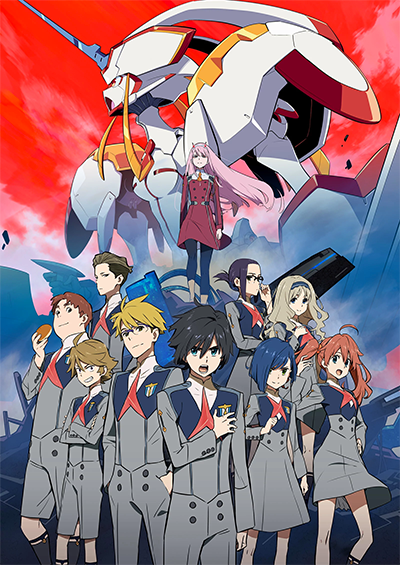
Zero Two & Hiro (Darling in the Franxx, 2018, Studio Trigger/CloverWorks) — A co-production between two studios, this one is defined by its mecha-piloting conceit literally requiring physical/emotional synchronization between pilots, making the romance mechanically inseparable from the plot rather than a subplot running alongside it.
Eren & Mikasa (Attack on Titan, 2013–2023, WIT Studio then MAPPA) — The most divisive entry here by design — Hajime Isayama's ending (2021 manga, animated in MAPPA's Final Season) recontextualizes their entire dynamic, which is exactly why it's still argued about years later rather than fondly remembered as straightforward romance.
Underrated Pairs
Tomoya & Nagisa (Clannad / Clannad: After Story, 2007–2008, Kyoto Animation) — This is the rare anime couple whose story continues past the wedding: After Story follows them into early marriage and parenthood, including the loss and hardship that come with it, which almost no other romance anime attempts.
Frieren & Himmel (Frieren: Beyond Journey's End, 2023, Madhouse) — Worth correcting: the pairing usually cited here isn't romantic in the traditional sense — Frieren is an elf mage who outlives her human hero companion Himmel, and the show's entire hook is her processing that loss decades later. It's less a "couple" than a study of grief across mismatched lifespans, which is why it hit differently than typical shonen romance and became one of 2023's most acclaimed series.
Isaac & Miria (Baccano!, 2007, Brain's Base) — Chaotic-good comic relief in a show otherwise full of immortals and mobsters; their relationship works because the show never treats their dynamic as a joke that needs resolving — they're just permanently, uncomplicatedly happy, which stands out in a cast full of tragic backstories.
What Actually Makes These Work
| Element | Weak Romance Writing | What These Couples Do Instead |
|---|---|---|
| Pacing | Sudden confession with no build-up | Toradora!, Horimiya build attraction through episodes of small interactions |
| Stakes | Romance exists in a vacuum | SAO, Darling in the Franxx tie the relationship to the plot's core mechanic |
| Payoff | Relationship declared, never shown functioning | Clannad shows the marriage, not just the wedding |
| Tragedy | Death used for shock value | Cowboy Bebop, Frieren use loss to recontextualize the whole story |
The Takeaway
If you're picking your next romance-adjacent watch based on this list, match the mode to your mood: Toradora! and Horimiya for grounded high-school romance without melodrama, Your Name for a self-contained emotional gut-punch in under two hours, Clannad: After Story if you want a romance that keeps going into adulthood, and Frieren if you want something closer to meditation on loss than conventional romance. What ties all of them together isn't a formula — it's that the writers were willing to let the relationship be inconvenient, slow, or genuinely sad instead of just satisfying.